

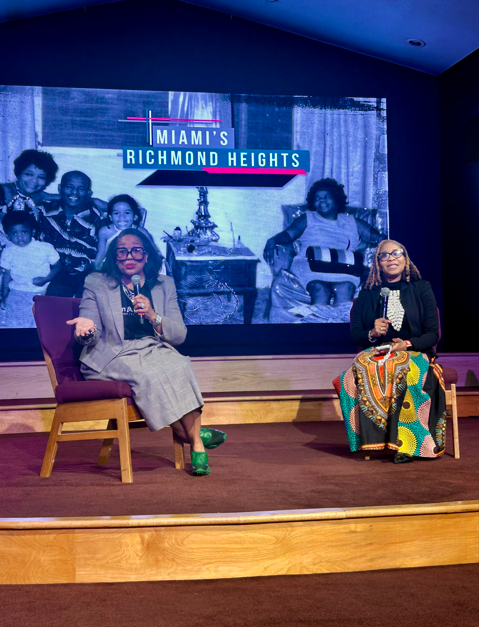
‘Miami’s Richmond Heights: The Black Shangri-La’ screens at The Purple Church in Honor of Black History
by Julia Franklin
Parishioners, longtime residents and youth groups gathered at the “Purple Church” on Sunday evening for a screening of “Miami’s Richmond Heights: The Black Shangri-La,” a Hip Rock Star Media documentary in partnership with The Historic Society. The documentary chronicles Richmond Heights, one of Florida’s most historically significant Black communities.
The event was hosted by the Black History Committee for The Purple Church. Chairwoman Ebonie Battle Williams welcomed attendees to reflect on the legacy of Richmond Heights — a neighborhood founded in 1949 in southwest Miami-Dade County and designed specifically for Black families during the era of Jim Crow segregation.
The film, produced and directed by Jessica Garrett Modkins, explores the origins of Richmond Heights as Florida’s first developed middle-class community for African Americans after World War II. Following the screening, Modkins participated in a question-and-answer session, sharing personal motivations behind the project and stories uncovered during years of research.
“My mother told me that the pioneers were passing away and with that, the history was leaving. She explained that I needed to come home to work on a book to ensure our history would not be forgotten,” Modkins told the audience. “Our history will not parish.”
Richmond Heights was built at a time when Black servicemen returning from World War II were often denied access to GI Bill benefits and Federal Housing Administration-backed loans. According to the documentary, developer Capt. Frank C. Martin sought to change that.
State Sen. Dwight Bullard, featured in the film, explains that while Eatonville is recognized as one of the first incorporated Black municipalities in Florida, Richmond Heights holds a distinct place in history.
“The community of Richmond Heights was established as the first middle-class community for African Americans in the state of Florida,” Bullard says in the documentary. “After World War II, the rest of the country was not allowing African-American soldiers to use their GI Bills for the purchase or down payment on homes. Captain Frank C. Martin understood their service and felt they deserved the same opportunity as any other soldier to establish a home.”
Martin, a white Army Air Corps captain who served alongside Black pilots known as the Tuskegee Airmen, identified a remote tract of land — described by early residents as “the boondocks” — where African Americans could build the American dream. Through connections that reportedly reached the White House, FHA approval was ultimately secured, allowing both veterans and civilians to finance homes in the new development.
The film also delves into lesser-known aspects of the neighborhood’s design. Modkins recounted how the streets were intentionally curved.
“The developer made the streets curved so that if the Ku Klux Klan ever thought it would be easy to get to Black residents to harm them, they would be met with obsticles,” she said. “It was intentional. Protection was built into the design.”
Residents in the film describe Richmond Heights as an oasis — deliberately segregated yet self-sustaining.
Jacqueline Cambridge Porter recalls growing up in what she and her peers called “our Shangri-La.”
“It was a Black oasis in the middle of nowhere,” she says. “There were no streetlights. We always tried to make it home before dark. At Christmas time, you’d see 35 or 40 kids skating down the street together. Nothing happened.”
Historian Dr. Graylyn Swilley Woods, another voice featured in the documentary, connects Richmond Heights’ founding to the broader historical context of Jim Crow.
“During Jim Crow, the whole idea was to separate as much as possible and to demean Black life as much as possible,” Swilley says. “When we talk about Black Lives Matter today, it has roots in that era. Jim Crow gave us independent institutions. It gave us a sense of purpose and identity. It forced us to be proud because those were the intangible things we had in order to survive.”
Swilley Woods describes Richmond Heights as a community that has “survived the test of time,” one of the few historically Black neighborhoods founded by and for African Americans from its inception.
“It’s a place we can call home, be proud of, and build communities that will last generations and generations,” he says. “That’s the beauty of what that era, as painful as it was, produced — sufficiency and the ability to remain self-sustaining.”
Frank Martin, son of the community’s founder, recounts in the film the challenges of securing FHA approval for civilian buyers. He describes how his father’s West Point connections ultimately helped unlock federal backing after local obstacles delayed progress.
As the screening concluded, audience members lingered, sharing their own memories and reflections. For many in attendance, the documentary served not only as a history lesson but as a call to stewardship.
The film also featured: Samuel & Queen Armstrong, Jubbie Deon Battle, Jubbie Battle, LaTeef Battle, Marvin Dunn, Patricia Harper Garrett, Robert Linton II, MD, MBA, Charles Minder, Melissa McGhee Proctor, Sheldrick Redwine, Dr. Alvin Smith, Larry Spring, LaTasha Stirrup, LaToya Stirrup, LaTrice Stirrup, Mark Valentine, and Avery Washington.
Richmond Heights, once isolated and unlit, now stands as a living testament to resilience, strategic vision and communal pride. And for Modkins, preserving those stories is as urgent as ever.
“If we don’t tell it,” she said, “it can be erased.”



